 Image Alt Text" />
Image Alt Text" />
No matter how much money you make, financial emergencies can happen. As a small business owner, you might be faced with a situation in which an employee requests a paycheck advance. You might also be asked questions about this process, and if it’s something your payroll team offers. Below are some common practices for providing a payroll advance, and tips for how to make it easy for both you and your employee.
A paycheck advance is an advance on a future paycheck that would normally come from an employer’s payroll cycle . Considered a short-term loan, a paycheck advance is agreed upon by both the employer and the employee and is typically repaid back to the employer from future paychecks. This is an optional benefit and intended only to be used in an emergency situation, such as a large unexpected expense. Because the employee is borrowing money from the next payday, paycheck advances should be used sparingly and with caution.
How to talk to your employees about paycheck advances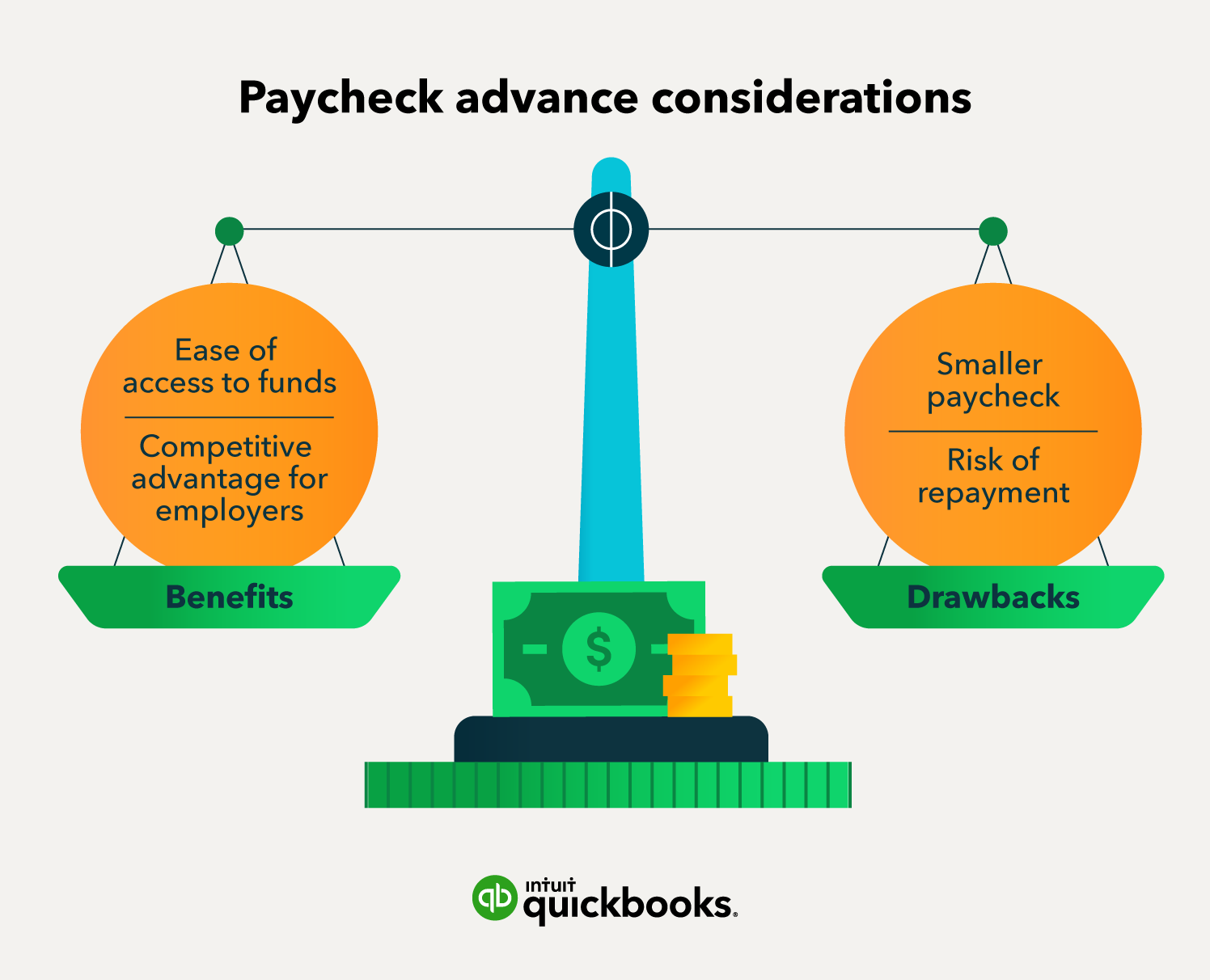
When speaking with your employee, they might mention the term “payday loan” or “cash advance.” It’s important to understand that a paycheck advance and a payday loan are not the same, even though they are often interchanged or confused.
Whereas a paycheck advance is a hassle-free, employer-based loan, a payday loan is provided through an outside payday lender at a much higher cost, usually $10–$30 per $100 borrowed . In some cases, payday lenders target individuals who need cash immediately and may not have other funding options available. In these cases, payday lenders are able to charge high interest rates and may charge additional fees if payment is not paid back on time. This is a different circumstance from the predominantly interest-free paycheck advance from the employer.
Before agreeing to take or provide a paycheck advance, the following benefits and drawbacks need to be considered:
Some benefits of a paycheck advance to the employee include:
While there are obvious benefits to the employee who is requesting a paycheck advance, offering paycheck advances when your employees need them can have some important benefits for your business as well:
While getting the funding they need has immediate benefits to employees, it’s important to note that there can be some drawbacks of paycheck advances too. These can include:
While it’s mostly beneficial for the employer to offer this type of benefit, paycheck advances do not come without a potential drawback:
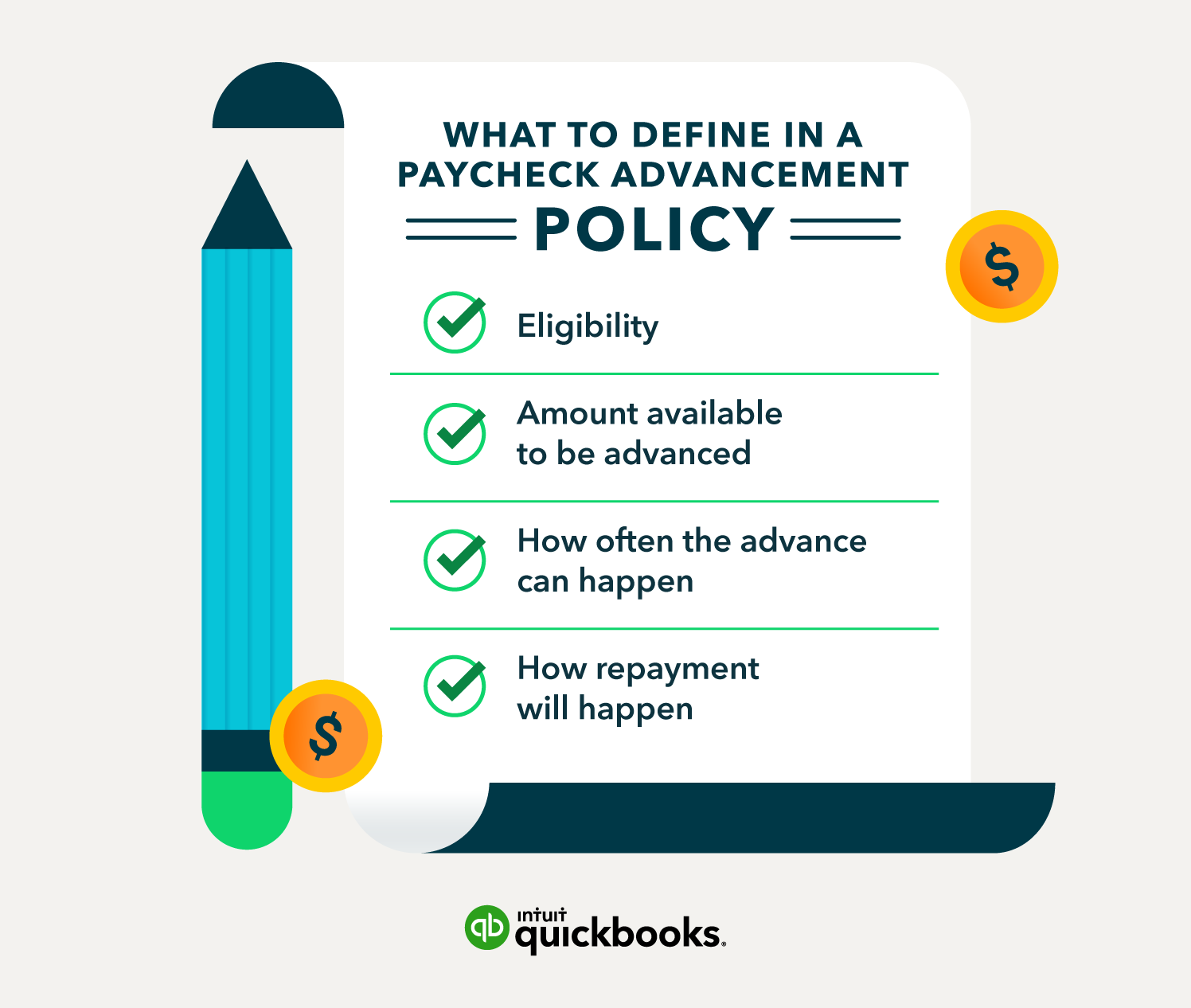
The best way to avoid complications with this type of request is to have a written policy in place, preferably before an employee needs the benefit. It can be helpful to define:
While you may want to make every employee eligible, it might make more sense for your company to limit the benefit to employees who have a certain tenure, or to limit it to employees who are in good standing with your company. You must also take into consideration the employee’s compensation type before agreeing to any advance.
Employers wishing to offer this option might also consider offering educational materials for financial literacy and financial planning to employees. While this might not mitigate the potential downfalls, it will provide a base of information to protect both parties and potentially lessen the need for paycheck advance requests in the future. Topics such as setting up an emergency fund, lowering credit card debt, or setting up and managing a savings account are great first steps.
How to complete a paycheck advance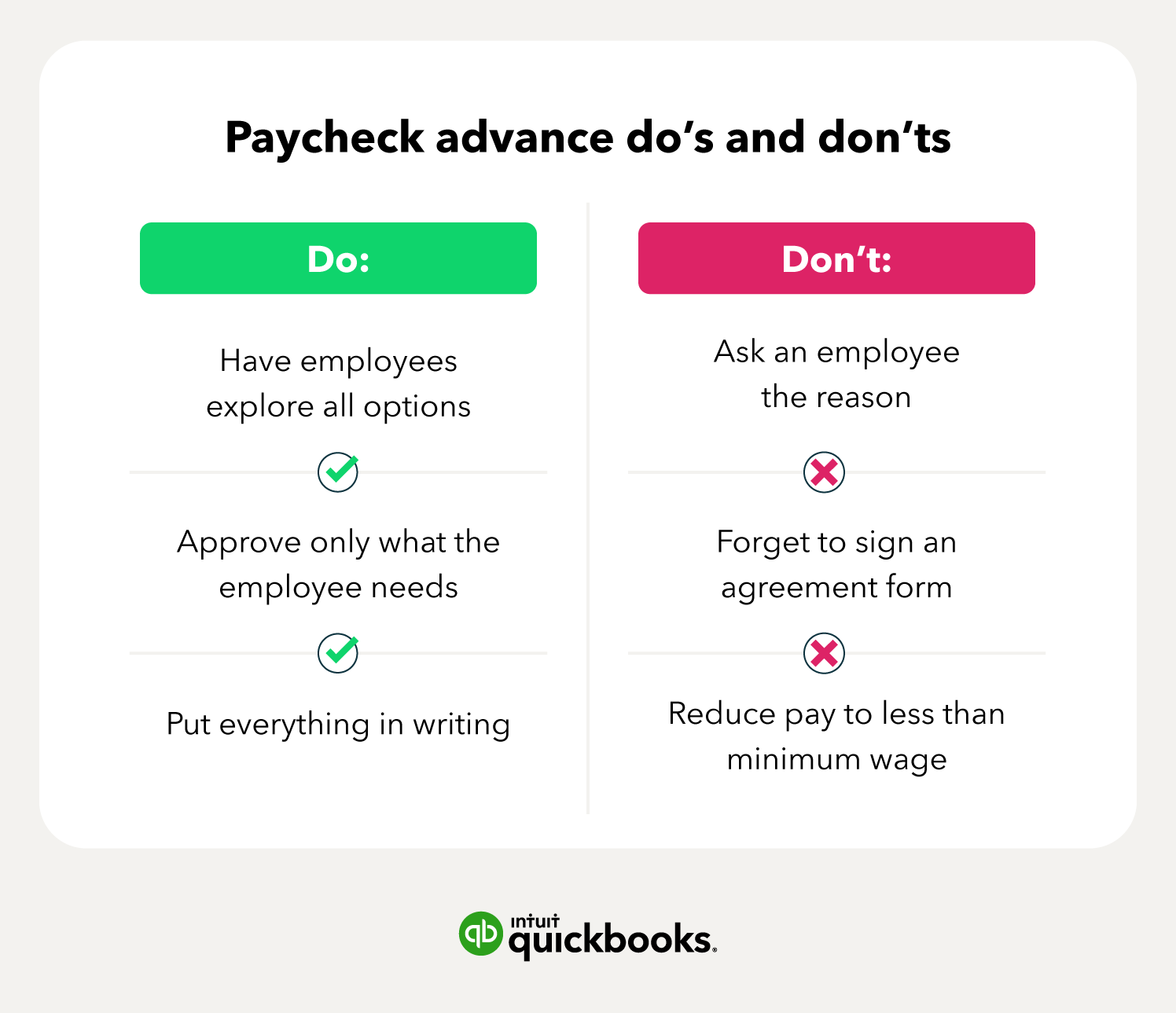
There are a few steps to take once an employee asks for a paycheck advance, both by the employee and by the employer. More specifically, the following needs to be done as soon as the request is made:
There are a few specific steps the employee must take to successfully request and be granted a paycheck advance, including:
As the employer, there are a few steps to take to help make a paycheck advance as smooth as possible.
Outside of the actual process, remember that confidentiality is key in this delicate circumstance. While you might want to confirm that the advance is necessary, you shouldn’t inquire what the money is going toward. This not only builds rapport with your employee but eliminates any potential discrimination accusations in the future.
Remember that the employee who is asking for a paycheck advance has most likely exhausted all options. Working with payroll to offer a paycheck advance to employees is sure to be beneficial and greatly appreciated.
Recommended for you
Payroll forms every business owner should have

What is payroll processing? How to process payroll step-by-step

DIY accounting: How to calculate payroll
January 23, 2020
We provide third-party links as a convenience and for informational purposes only. Intuit does not endorse or approve these products and services, or the opinions of these corporations or organizations or individuals. Intuit accepts no responsibility for the accuracy, legality, or content on these sites.
**Product information
QuickBooks Live Assisted Bookkeeping: This is a monthly subscription service offering ongoing guidance on how to manage your books that you maintain full ownership and control. When you request a session with a Live Bookkeeper, they can provide guidance on topics including: bookkeeping automation, categorization, financial reports and dashboards, reconciliation, and workflow creation and management. They can also answer specific questions related to your books and your business. Some basic bookkeeping services may not be included and will be determined by your Live Bookkeeper. The Live Bookkeeper will provide help based on the information you provide.
QuickBooks Live Full-Service Bookkeeping: This is a combination service that includes QuickBooks Live Cleanup and QuickBooks Live Monthly Bookkeeping.
1. QuickBooks Online Advanced supports the upload of 1000 transaction lines for invoices at one time. 37% faster based off of internal tests comparing QuickBooks Online regular invoice workflow with QuickBooks Online Advanced multiple invoice workflow.
2. Access to Priority Circle and its benefits are available only to customers located in the 50 United States, including DC, who have an active, paid subscription to QuickBooks Desktop Enterprise or QuickBooks Online Advanced. Eligibility criteria may apply to certain products. When customers no longer have an active, paid subscription, they will not be eligible to receive benefits. Phone and messaging premium support is available 24/7. Support hours exclude occasional downtime due to system and server maintenance, company events, observed U.S. holidays and events beyond our control. Intuit reserves the right to change these hours without notice. Terms, conditions, pricing, service, support options, and support team members are subject to change without notice.
3. For hours of support and how to contact support, click here.
4. With our Tax Penalty Protection: If you receive a tax notice and send it to us within 15-days of the tax notice we will cover the payroll tax penalty, up to $25,000. Additional conditions and restrictions apply. See more information about the guarantee here: https://payroll.intuit.com/disclosure/.
Terms, conditions, pricing, special features, and service and support options subject to change without notice.
QuickBooks Payments: QuickBooks Payments account subject to eligibility criteria, credit, and application approval. Subscription to QuickBooks Online required. Money movement services are provided by Intuit Payments Inc., licensed as a Money Transmitter by the New York State Department of Financial Services. For more information about Intuit Payments' money transmission licenses, please visit https://www.intuit.com/legal/licenses/payment-licenses/.
QuickBooks Money: QuickBooks Money is a standalone Intuit offering that includes QuickBooks Payments and QuickBooks Checking. Intuit accounts are subject to eligibility criteria, credit, and application approval. Banking services provided by and the QuickBooks Visa® Debit Card is issued by Green Dot Bank, Member FDIC, pursuant to license from Visa U.S.A., Inc. Visa is a registered trademark of Visa International Service Association. QuickBooks Money Deposit Account Agreement applies. Banking services and debit card opening are subject to identity verification and approval by Green Dot Bank. Money movement services are provided by Intuit Payments Inc., licensed as a Money Transmitter by the New York State Department of Financial Services.
QuickBooks Commerce Integration: QuickBooks Online and QuickBooks Commerce sold separately. Integration available.
QuickBooks Live Bookkeeping Guided Setup: The QuickBooks Live Bookkeeping Guided Setup is a one-time virtual session with a QuickBooks expert. It’s available to new QuickBooks Online monthly subscribers who are within the first 30 days of their subscription. The QuickBooks Live Bookkeeping Guided Setup service includes: providing the customer with instructions on how to set up chart of accounts; customized invoices and setup reminders; connecting bank accounts and credit cards. The QuickBooks Live Bookkeeping Guided Setup is not available for QuickBooks trial and QuickBooks Self Employed offerings, and does not include desktop migration, Payroll setup or services. Your expert will only guide the process of setting up a QuickBooks Online account. Terms, conditions, pricing, special features, and service and support options subject to change without notice.
